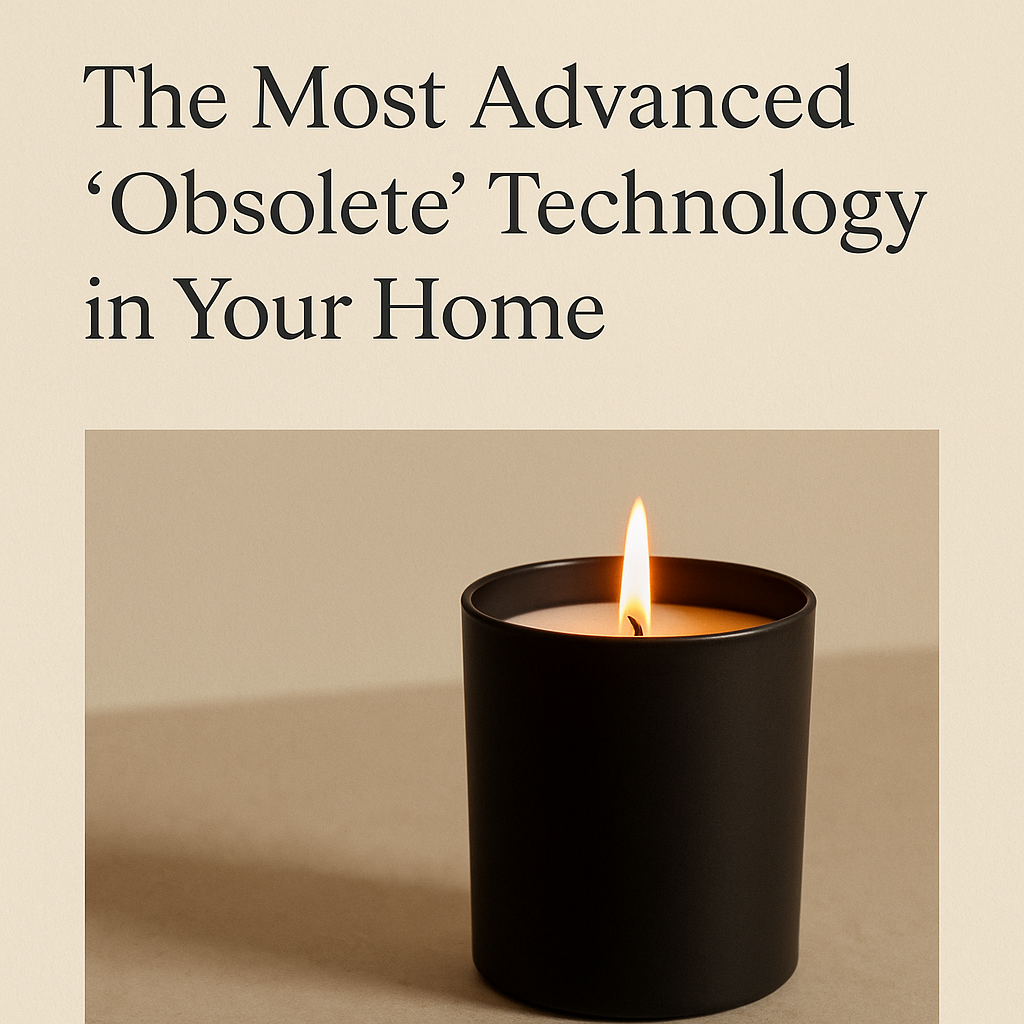
The Most Advanced “Obsolete” Technology in Your Home
When electricity arrived, candles lost their job.
They no longer had to keep families from stumbling through night kitchens or squinting over books. The incandescent bulb, then compact fluorescents, then LEDs—each wave pushed the candle further from necessity. By a strict definition of utility, the candle should have vanished.
And yet, here we are. We still buy them, gift them, light them on ordinary Tuesdays and significant Sundays. We watch a small fire soften the air and—without discussion—agree that the room feels different.
Why hasn’t this “obsolete” technology gone away?
Because technology is bigger than function. Technology is the way we transform intention into a result. On that measure, the candle is thriving. It’s simply doing a different job now—one that modern devices can’t replicate.
Below is a meditation on why the candle persists, and how to use it as the deliberate, luxury piece of “slow tech” it has become.
Utility vs. Use (and Why the Candle Survived)
Utility is about tasks: Illuminate the room.
Use is about effects: Change how the room feels—and how I feel in it.
Electric light erased the candle’s utility. But the candle’s use grew more vital in a world saturated with light, speed, and screens. A bulb can brighten, but it cannot hush. It cannot frame time, or signal a ritual, or carry memory the way scent does. The candle’s use is affective, not functional. It isn’t about seeing; it’s about sensing.
Think of a candle as a human-scale interface:
-
Single-purpose on-ramp to presence. One strike, one flame. You’re here now.
-
Thermal tempo. Wax melts at human speed; heat blooms gradually; time dilates.
-
Ambient storytelling. Scent does what language struggles to do—it moves through you rather than at you.
In other words: the candle’s user experience is primitive in all the best ways.
What a Flame Does That a Screen Can’t
Modern life is defined by attention fracking—everyone drilling your focus for microseconds at a time. The candle answers with an analog counter-move.
-
It narrows the moment. A small, living light creates a perimeter around your evening: now starts here.
-
It adds texture to air. Fragrance turns the invisible visible. You can feel a room fill; it’s like a slow crescendo for the nose.
-
It’s ritual hardware. A match is a power button you can hear, smell, and see. Rituals that involve a tiny risk (open flame) carry seriousness. Your body pays attention.
This is why we light candles for power outages, birthdays, vows, vigils. The candle’s job is to dignify time.
Scent: Memory’s Fast Lane
If flame structures time, fragrance structures memory.
Smell bypasses much of your brain’s verbal gatekeeping. Where light is about clarity, scent is about connection—to people, places, versions of yourself you’ve been. A great candle is a crafted shortcut to an inner room you want to visit.
That’s the design philosophy behind our Signature Series at CandleCraft Collective:
-
Muse: leather, cardamom, chai—an atmosphere for creative focus and warm nostalgia. A cue for journaling, drafting, or deep work.
-
Haven: linen, neroli, white tea, sandalwood—spa-level clarity and calm for morning routines or mindful resets.
-
Soirée: champagne, jasmine & neroli, white currant, tonka, cashmere musk—effervescent connection for aperitivo hour and easy gatherings.
-
Hearth: vanilla, smoked cedar, clove—grounded comfort for evenings in, belonging, and exhale.
Each one is built not just to smell good, but to do something—to be a tool for a feeling.
The Candle as “Slow Tech”
If you think of your home as an ecosystem of tools, the candle is your slow-tech module—low data, high meaning.
-
Latency you can love. It takes a minute for wax to pool and fragrance to bloom. That delay is not a bug; it’s a feature. It invites anticipation.
-
Single-threaded by design. You can’t doomscroll a flame. The candle asks nothing from you but attention, offered in brief glances.
-
Human-scale feedback loop. The room warms; your shoulders drop; conversation lengthens. That’s an elegant closed loop—no app required.
Luxury, in this frame, is not excess. Luxury is the quality of your inputs—materials, craftsmanship, and the intention you encode into an object before it meets a life.
Materials Matter (Because Performance Is Part of Meaning)
Great candles are quiet feats of material science in service of sensation:
-
Wax systems (we use a soy-coconut blend) determine melt behavior, hot throw, and burn consistency.
-
Wick architecture controls flame size and how the “fragrance engine” breathes.
-
Oils and ratios—not just notes, but how they unfold over time—decide the arc of the experience.
We obsess over these because performance is how a candle keeps its promise. If a candle tunnels, smokes, or under-throws, it breaks the spell. Craft is not a flex; it’s a covenant with your evening.
Personalization: The New Power Switch
Obsolescence pushed candles toward experience. Personalization finishes the journey.
A custom blend is more than novelty; it’s an identity layer for your space. Your home’s scent becomes your unspoken greeting—the thing guests notice before they know they’ve noticed. It can support your routines (morning clarity, social ease, bedtime wind-down) with precision.
Our scent quiz exists for this reason: it translates your preferences—“Sweet & Cozy,” “Smoky & Deep,” “Fresh & Airy”—into a formula tuned for an 8oz vessel at the proper fragrance load. The output isn’t merely a candle; it’s your candle, engineered to do a job in your life.
Why Candles Endure in a Fully Lit World
Electricity solved for light. Candles solve for meaning—for mood, memory, and the way a home receives you. When a technology loses one utility, it often migrates to another layer of the human stack:
-
The wristwatch once kept time; now it keeps identity and ritual.
-
The printed book ceded distribution to screens; it kept presence and place in a room.
-
The candle ceded light; it kept atmosphere.
Obsolescence didn’t kill the candle. It purified it.
A Practical Guide to Using Candles as Technology
Think like a designer. Assign jobs. Measure outcomes—not in lumens, but in feeling.
-
Define the task.
-
Focus (Muse) for writing, reading, or deep work.
-
Reset (Haven) for morning breath and post-work decompression.
-
Connection (Soirée) for small dinners, cocktails, and conversation.
-
Belonging (Hearth) for nights in, journaling, and rainy Sundays.
-
-
Place with intention.
-
Entry table for first-impression mood.
-
Kitchen island for transition from task to together.
-
Nightstand for pre-sleep wind-down.
-
-
Time-box the burn.
-
Light at the start of a ritual; extinguish when you’ve completed it. Train your nervous system to associate the arc of the flame with that state.
-
-
Layer thoughtfully.
-
One hero candle at a time. Add a second only if it extends the story (e.g., Haven in the bath, Hearth in the living room after).
-
-
Care equals performance.
-
Trim wicks to about ¼". Let the first burn reach a full melt pool. Store away from heat and sunlight. Small habits, big payoff.
-
The Luxury of Attention
Candles are honest objects. They won’t ping you. They won’t demand a password. They’re not “smart,” but they make rooms wiser. And they remind us that the most precious luxury is not the thing we buy; it’s the attention we’re willing to give.
A candle is a ten-second ritual that can change the next two hours. That’s an astonishing return on intention.
Electricity made candles obsolete for light. Life made them essential for living.
When you’re ready to design your home’s emotional architecture: by room, by ritual, by season, we’re here to help. Start with the Signature Series if you want a ready-made mood, or build a Custom Blend if you want a scent that wears your name on the inside. Either way, consider the candle not as a decoration but as a deliberate tool:
A small, ancient technology, still the most elegant way to turn presence on.